WALLCOVERING GUIDE
Choosing wallcovering is about more than finding a pattern you love. Material, texture, performance, the room and the property all influence the right specification. This guide introduces the major wallcovering families and explains why professional product selection matters.
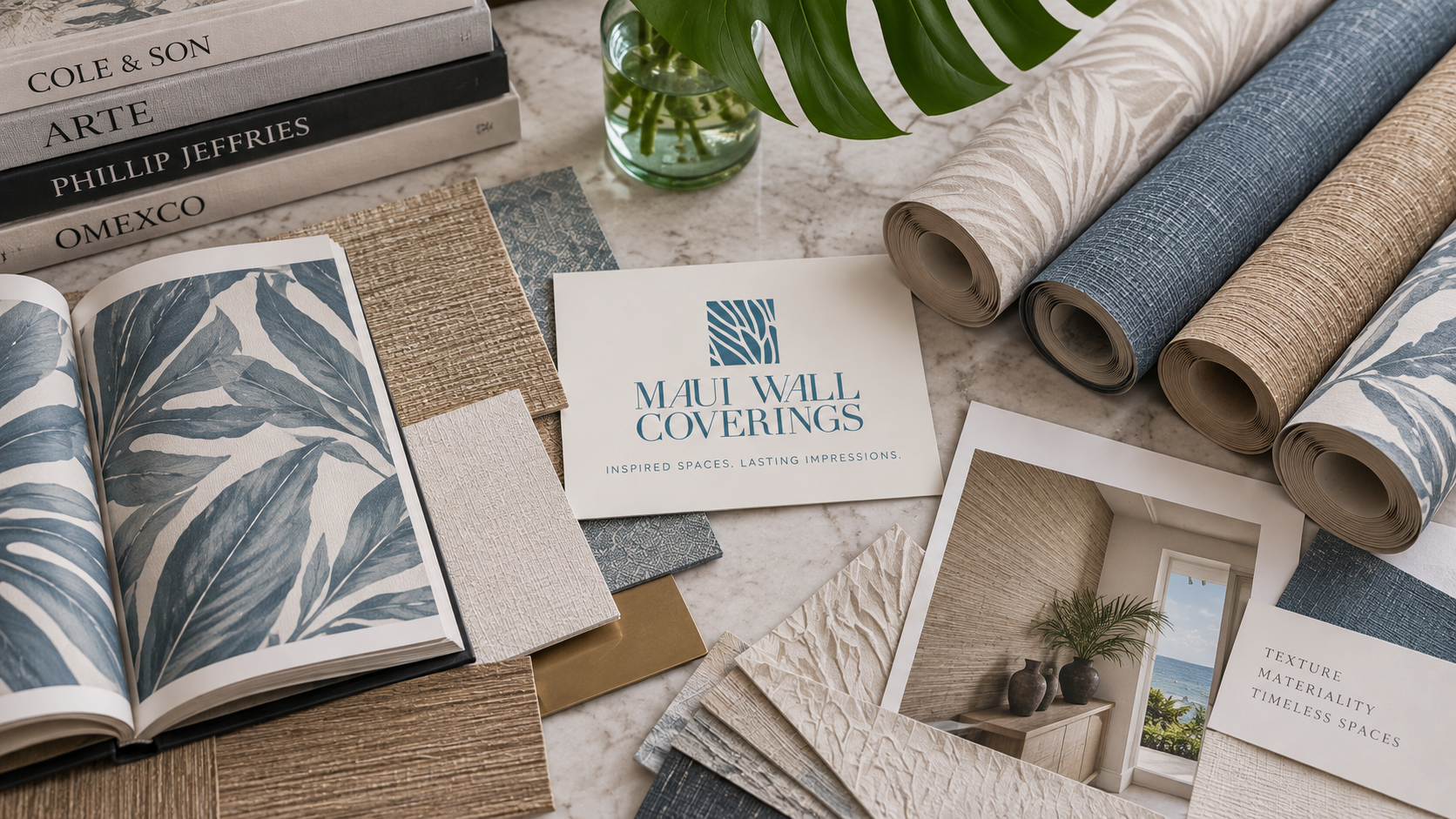
Wallcovering can transform a room through color, pattern and scale—but the material itself is just as important as the design.
Today's wallcoverings range from printed papers and non-wovens to grasscloth, textiles, cork, vinyl, murals, metallic surfaces and highly specialized architectural finishes. They don't all behave the same way.
A wallcovering that makes sense in a quiet bedroom may not be appropriate for a frequently used bathroom, hotel corridor or commercial space. Even two products that appear similar online can have very different constructions and performance characteristics.
At Maui Wall Coverings, we help clients move beyond simply finding a pattern they like to selecting a wallcovering that makes sense for the design, space and project conditions.
One of the easiest mistakes when shopping for wallpaper is starting with thousands of patterns before defining what the room actually needs.
A primary bedroom, powder room, restaurant, resort residence and commercial corridor each place different demands on a wall finish. The location can influence considerations such as durability, cleanability, moisture exposure, natural variation, traffic and maintenance.
On Maui, the property itself adds another layer. Coastal exposure, elevation, air conditioning, natural ventilation and building conditions can vary significantly.
That doesn't mean clients need to become wallcovering experts before choosing a product. It means the room should be part of the selection process.
Paper remains an important category, particularly in design-driven residential interiors. It can produce beautiful color, detail and artistic effects and is available across traditional, contemporary and highly specialized collections.
But products within the category vary. The fact that something is described as “paper” doesn't tell us everything we need to know about where it should be used. For MWC, the specific product and proposed location matter more than the category name alone.
Non-woven is one of the most common terms clients encounter when shopping for contemporary wallpaper. It generally refers to aspects of the wallcovering's construction rather than a particular aesthetic.
That is why we don't use “non-woven” as a universal indication that a product is appropriate for a particular room. The complete wallcovering still needs to be considered.
Performance-oriented wallcoverings can be useful where durability, cleanability or higher levels of use are important. This category is especially relevant to hospitality and commercial projects, although certain products can also be appropriate in residential applications.
The important distinction is that “vinyl” does not automatically mean “right for the project.” Products vary significantly in construction, appearance and intended performance. MWC reviews the actual product specifications when performance is an important part of the project.
Natural wallcoverings are valued precisely because they do not look completely manufactured. Grasscloth, sisal and other natural fibers can introduce texture, depth and subtle variation that printed products cannot fully reproduce.
That natural character can also mean visible seams, tonal differences and variation from panel to panel. For the right room, those characteristics can be part of what makes the installation exceptional.
The important question is not whether grasscloth is “good” or “bad” for Hawaii. It is whether a specific natural wallcovering makes sense in a specific location.
Textile wallcoverings introduce softness, depth and a tactile quality that can dramatically change how a room feels. Some are created primarily for sophisticated residential environments, while others are engineered for more demanding applications.
Wallcovering does not have to look like traditional wallpaper. Cork, wood veneer and other natural surfaces allow the wall itself to become a material element within the architecture.
These products can be particularly effective when the design objective is less about repeating pattern and more about texture and materiality.
Metallic finishes can react dramatically to natural and artificial light. They can create depth and movement that is difficult to understand from a small online image.
They can also place greater visual emphasis on the wall itself, making product selection and existing wall conditions especially important.
Murals introduce another consideration: composition. Instead of repeating indefinitely across the wall, the image relates to the architecture.
Doors, windows, furniture, ceiling height and the primary viewing position can all affect how the finished mural reads in the room. This is an area where MWC's design assistance and visualization services can be particularly useful before material is ordered.
Not every wall needs a dramatic motif. Some of the most sophisticated wallcovering installations rely primarily on texture.
Natural fibers can introduce irregularity. Textile can soften a room. Cork can create organic depth. Metallic surfaces can respond to changing light. Subtle embossed materials can create shadows that change throughout the day.
This is also why we encourage clients to review physical samples whenever practical. A screen can communicate pattern. It is much less reliable at communicating texture, sheen, scale and natural variation.
Performance and aesthetics should not be treated as separate decisions.
A beautiful product that is poorly matched to the space can create unnecessary compromises. Conversely, choosing solely for durability can eliminate materials that might have been perfectly appropriate.
For some projects, maintenance and cleanability may be important. For others, natural texture or handcrafted character may take priority. Hospitality and commercial projects can introduce additional performance and specification requirements.
MWC evaluates those requirements against the actual products being considered rather than relying on broad rules about material categories. That product-specific evaluation is part of our consultation and specification service.
Wallcovering is unusually difficult to evaluate from a website alone. Color varies between screens. Pattern scale can be deceptive. Metallic surfaces change with light. Natural materials can vary from sample to sample.
A physical sample provides information that a digital image cannot.
The MWC Studio is designed around that process. Rather than asking clients to search an unlimited catalog without direction, we can help narrow the field according to the project and then compare relevant materials, textures and design directions in person.
You do not need to arrive knowing the technical category or construction you need.
You can arrive saying, “I want this room to feel warmer,” “I love this pattern, but I don't know whether it makes sense for my bathroom,” or simply, “I want something special on this wall.”
Determining which products can accomplish that objective is part of what we do.
Finding a wallcovering you love is the beginning. The next step is determining whether the material, room, wall conditions, project requirements and design intent work together.
That is where professional specification becomes valuable.
Maui Wall Coverings can help connect:
Design Direction → Samples → Product Selection → Specification → Estimating → Procurement → Preparation Coordination → Professional Installation
The technical decision-making behind that process remains project-specific because every product and property can present different requirements.
You don't need to search through thousands of products before contacting us.
Bring an inspiration image, architectural plans, fabric or finish samples, a wallpaper you've already found—or simply an idea for how you want the room to feel.
Visit the MWC Studio to explore wallcovering materials and samples with professional design guidance.
Already found a wallcovering? Send us the manufacturer and pattern information and we can help determine the appropriate next step for your Maui project.
Managing a Maui property from off island? MWC can coordinate selection, samples, estimating, procurement and installation locally.
