WALLCOVERING GUIDE
Wallpaper is part of a much larger world of wall finishes. This guide explains how decorative papers, natural fibers, textiles, murals, performance materials and specialty surfaces fit within the broader wallcovering category—and why that distinction creates more design possibilities.
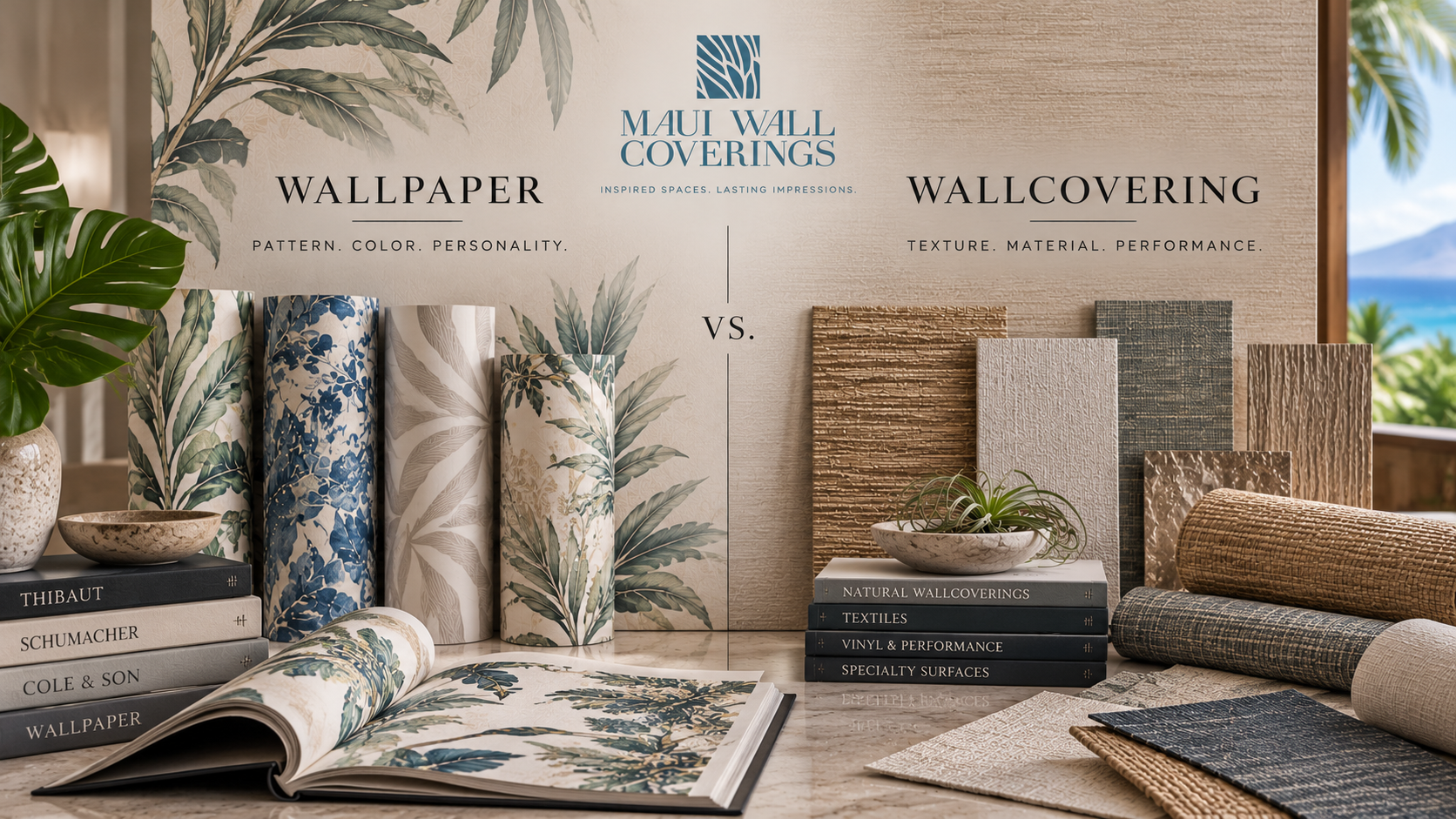
Most people use the word wallpaper to describe almost anything decorative that is installed on a wall. There is nothing wrong with that.
But once you begin working with designers, architects, manufacturers or commercial projects, you will also hear the term wallcovering.
Wallcovering is the broader category. It includes familiar decorative wallpaper, but it can also include natural fibers, textiles, vinyl and performance materials, cork, wood veneer, metallic surfaces, murals and other specialty finishes.
Understanding that distinction opens up considerably more design possibilities.
At Maui Wall Coverings, we use both terms depending on the client and project. What matters is not the terminology—it is finding the right material for the wall.
Wallpaper is generally the term people are most familiar with.
It often refers to decorative wall finishes supplied in rolls or panels and available in an enormous range of patterns, colors and textures.
Wallpaper can be understated or dramatic, traditional or contemporary, mass-produced or handcrafted. It remains one of the most effective ways to introduce pattern and visual identity into a room.
But thinking only in terms of “wallpaper” can unintentionally limit the search to printed decorative products. The wallcovering market is much broader.
Wallcovering is an umbrella term for materials designed to finish and enhance walls.
Some look exactly like what most people would call wallpaper. Others do not.
A wallcovering might have the tactile character of woven fiber, the depth of cork, the softness of textile, the reflective quality of a metallic surface or the durability required for a hospitality environment.
Wallpaper can be a wallcovering, but wallcovering is not limited to traditional wallpaper.
That distinction becomes especially useful when a project is being designed around materials rather than simply patterns.
Paint primarily changes color.
Wallcovering can change color, pattern, texture, reflectivity, scale and materiality at the same time.
A quiet woven texture can add warmth without introducing an obvious pattern. A natural fiber can make a large wall feel more tactile. A metallic surface can respond to changing daylight. A mural can turn architecture into a composition. A performance wallcovering can provide a designed finish while addressing the needs of a demanding commercial environment.
This is why MWC approaches wallcovering as an interior finish category, not simply as decoration.
Wallpaper is often associated with a single statement wall. That can work beautifully, but it is only one application.
Wallcovering can define an entire room, create continuity through a hallway, add intimacy to a powder room, introduce texture behind built-ins or become part of the architectural language of a residence.
In luxury residential work, subtle materiality can sometimes have more impact than a bold pattern.
The question becomes less “Where should we put wallpaper?” and more “What should this wall contribute to the room?”
Grasscloth, sisal, cork and other natural surfaces introduce real material variation.
Their appeal often comes from the fact that they are not perfectly uniform. Fibers, tones, textures and panels can vary.
That character can produce extraordinary interiors when it is understood and specified intentionally.
Natural wallcoverings are therefore not simply a visual alternative to printed wallpaper. They are a distinct material choice with their own characteristics and appropriate applications.
Textile wallcoverings can introduce softness and depth that printed products cannot fully reproduce.
Other specialty products can incorporate dimensional surfaces, reflective finishes, handcrafted elements or unconventional materials.
These products are one reason reviewing wallcovering solely through small online images can be limiting. Texture, scale, sheen and material variation often need to be experienced physically.
The MWC Studio gives clients and design professionals a place to compare these qualities through samples rather than relying only on a screen.
The distinction between wallpaper and wallcovering becomes particularly important in hospitality and commercial projects.
A hotel corridor, restaurant, resort, office or other frequently used space may require more than an attractive surface.
Durability, maintenance, cleanability and project-specific performance requirements can become part of the specification.
Commercial wallcoverings are available in an enormous range of designs, so performance does not necessarily mean sacrificing aesthetics.
MWC can assist designers, architects, contractors and hospitality teams with product sourcing and wallcovering specification for Maui projects.
Murals have expanded considerably beyond traditional scenic wallpaper.
Contemporary mural systems can range from subtle abstract compositions to large-scale artwork, botanical imagery, architectural graphics and custom designs.
Unlike a repeating pattern, a mural relates directly to the dimensions and architecture of the wall. That makes scale and placement particularly important.
MWC can assist with visualization and design placement so clients can understand how a mural relates to the room before committing to the finished product.
There is no need to decide whether you need “wallpaper” or “wallcovering” before contacting MWC.
Those categories are useful for understanding the market, but they are not where we want the client's decision process to end.
The more useful questions concern how you want the room to feel, what role the wall should play in the design, whether texture, pattern, materiality or performance is the priority, and what type of space is being considered.
MWC uses those answers to narrow the enormous wallcovering market into products relevant to the actual project. The detailed product qualification and specification process remains part of our professional service.
Some clients already have an interior designer or architect. We work collaboratively with them as the specialized wallcovering resource.
Other clients do not.
You do not need to engage a full interior design firm simply because you need professional guidance selecting wallcovering.
MWC provides wallcovering-focused design assistance, including product sourcing, samples, material and pattern guidance, and visualization when appropriate.
Whether the final selection is a printed wallpaper, grasscloth, textile, mural or specialty architectural surface, MWC can connect the project through:
Design Assistance → Product Selection → Specification → Estimating → Procurement → Preparation Coordination → Professional Installation
The client sees one connected process rather than having to independently coordinate a product seller, technical resource and installer.
That is the larger idea behind Maui Wall Coverings.
If you already know exactly what you want, bring us the manufacturer and pattern information.
If you don't, that is equally appropriate.
Bring an inspiration image, fabric sample, architectural plan, photograph of the room—or simply an idea for how you want the space to feel.
At the MWC Studio, we can help translate that starting point into relevant materials and samples.
Homeowners: explore wallcovering without needing to understand the technical categories first.
Designers & architects: use MWC as a specialized sourcing, specification and installation resource.
Hospitality & commercial teams: contact us for project-specific product and performance requirements.
Off-island owners: MWC can manage the wallcovering process locally for your Maui property.
